
A baltic birch plywood primer
It seems like every other month or so, someone asks about Baltic Birch plywood on one of the forums I frequent. I think one of reasons so many questions exist, is because there isn’t much information on the net. The following is a basic primer on Baltic Birch plywood, generated from various internet sources I’ve come across.
Region of origin – As the name implies, Baltic Birch plywood is produced from Birch trees from the Baltic region of Europe. The two main producers appear to be Russia & Finland.
Thickness – True Baltic Birch plywood only comes in metric thicknesses. The most common sizes found in North America are 6mm, 12mm, & 18mm. Additionally 3mm, 9mm, 15mm, & 25mm can occasionally be found in a narrower range of grades.
Size – You used to only be able to find Baltic Birch plywood in 5’x5′ sheets. Recently people have reported finding 4’x8′ sheets. Supposedly Manufactures have become wise to the fact that plywood comes in 4’x8′ sheets in North America, and have started producing to that size.
Plies – Baltic Birch plywood has more plies for a given thickness that North American plywood. Additionally every ply is birch, unlike a lot of plywood of North American origin that has hardwood exterior & softwood interior plys. The following chart list ply count by thickness.
- 3mm – 3 ply
- 6mm – 5 ply
- 9mm – 7ply
- 12mm – 9 ply
- 15mm – 11 ply
- 18mm – 13 ply
- 25mm – 18 ply
Grading – Baltic Birch does not follow ANSI grading standards most are familiar with, instead the following grading scheme is used. A typical grade found in quality furniture is B/BB.
- Grade “B” – Selected one-piece face generally light and even in color. Occasional small pin knots and some brown streaks may be allowed. Intended for natural finish. No patches allowed.
- Grade “BB” – One-piece face generally light and even in color. Occasional sound tight knots are permitted but open knots and defects in BB have been cut out and replaced with small ovular or round veneer patches before gluing. The veneer selected for the patches is of the same general color as the basic face veneer.
- Grade “CP” – One-piece face very close to grade BB. Rejected from BB for small defects with more streaking. Occasional hairline splits of less than .5mm are allowed. The oval or round patches may or may not be matched for color with the base face veneer. There will normally be more patches per face than the BB grade.
- Grade “C” – One-piece utility grade veneer. Open defects and open splits are allowed.
The following images are of some Baltic Birch plywood of Russian origin I purchased a few days ago.
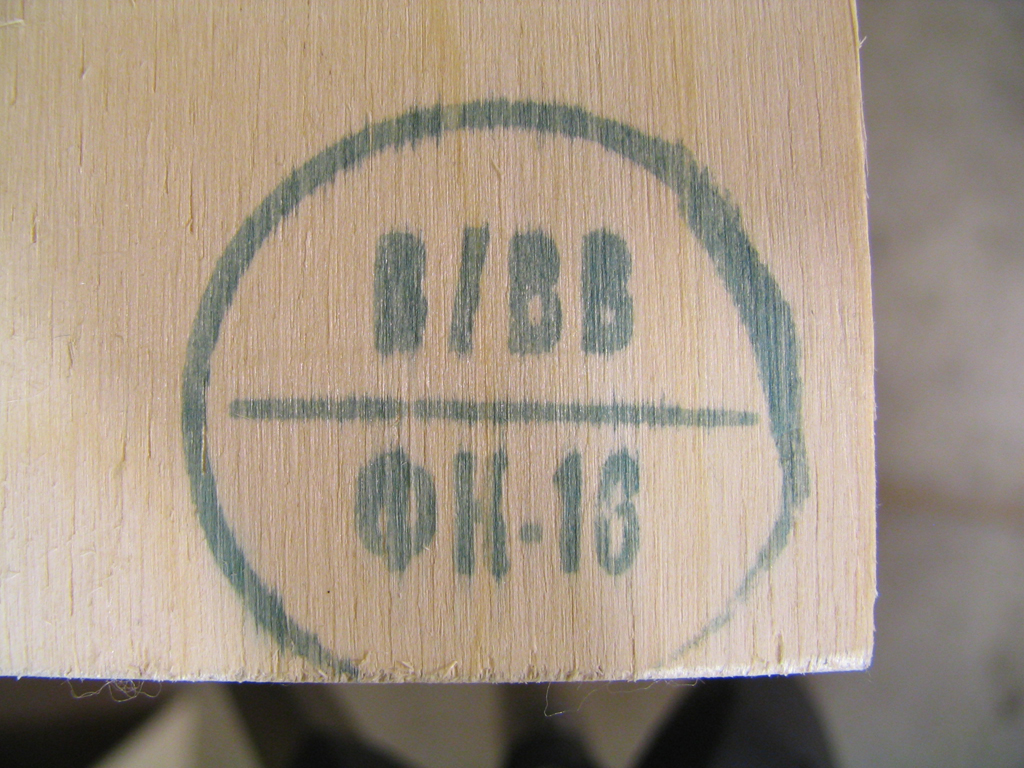
A quick way to Identify Baltic Birch of Russian origin is look for a stamp/marking that contains cyrillic characters.
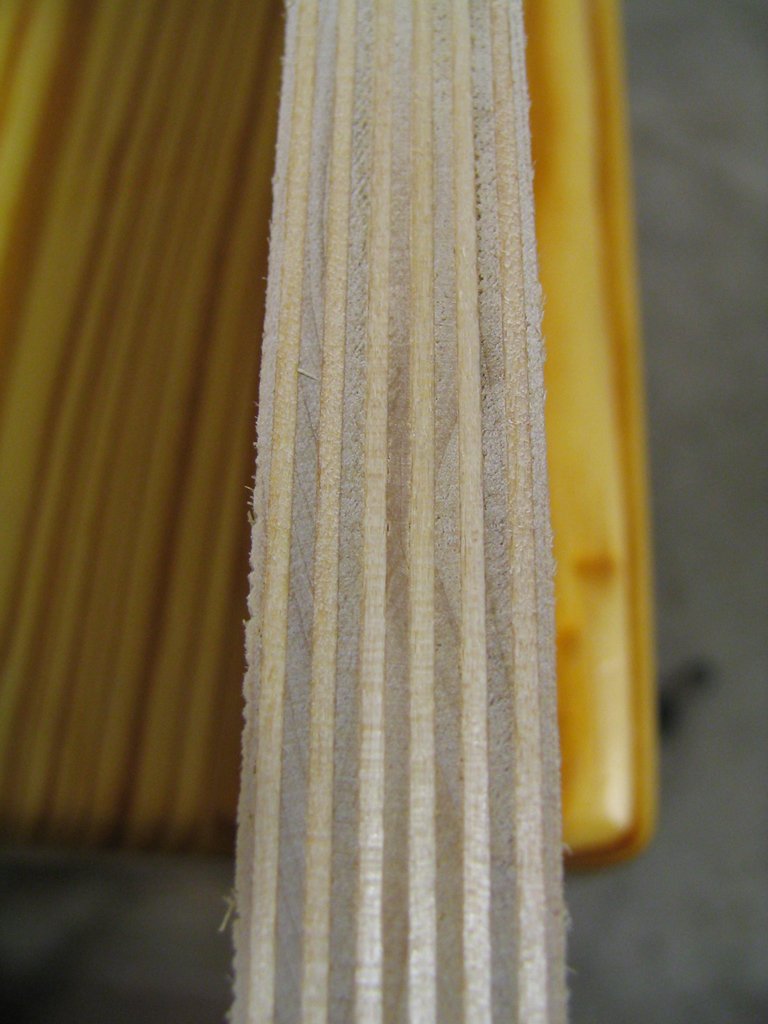
This is how Baltic Birch normally looks, plies of consistent thickness, and free of voids. If voids do occur, they are usually very small.
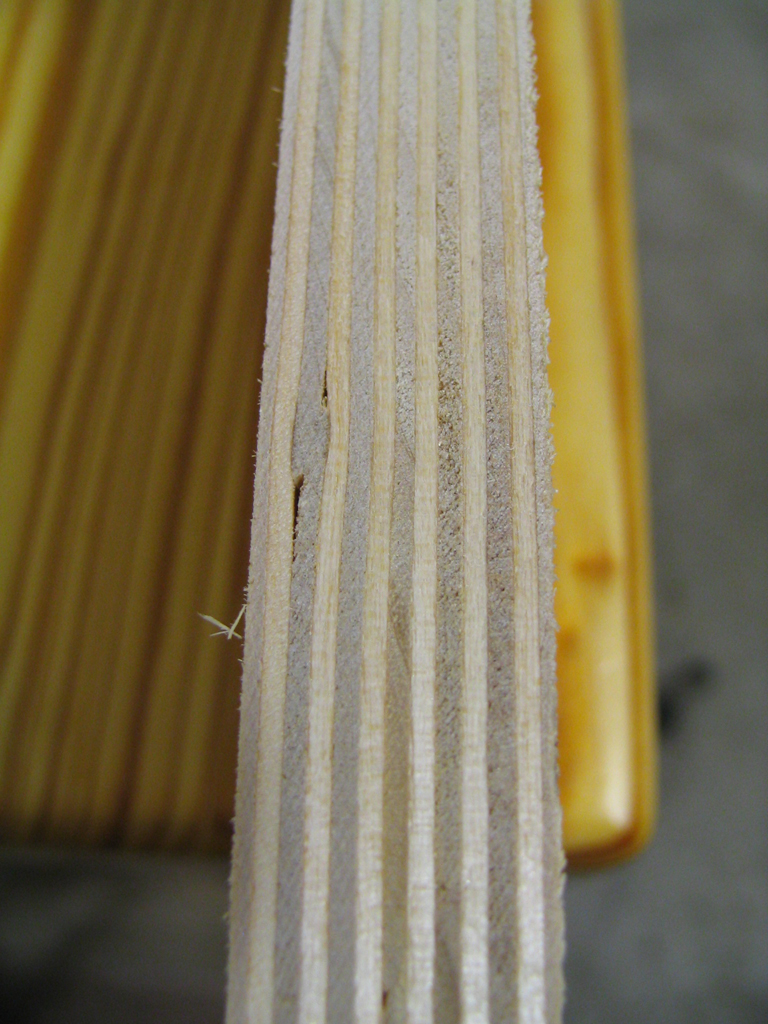
Defects are uncommon, but still possible in Baltic Birch. This is the only one I found in the 5 sheets I purchased.
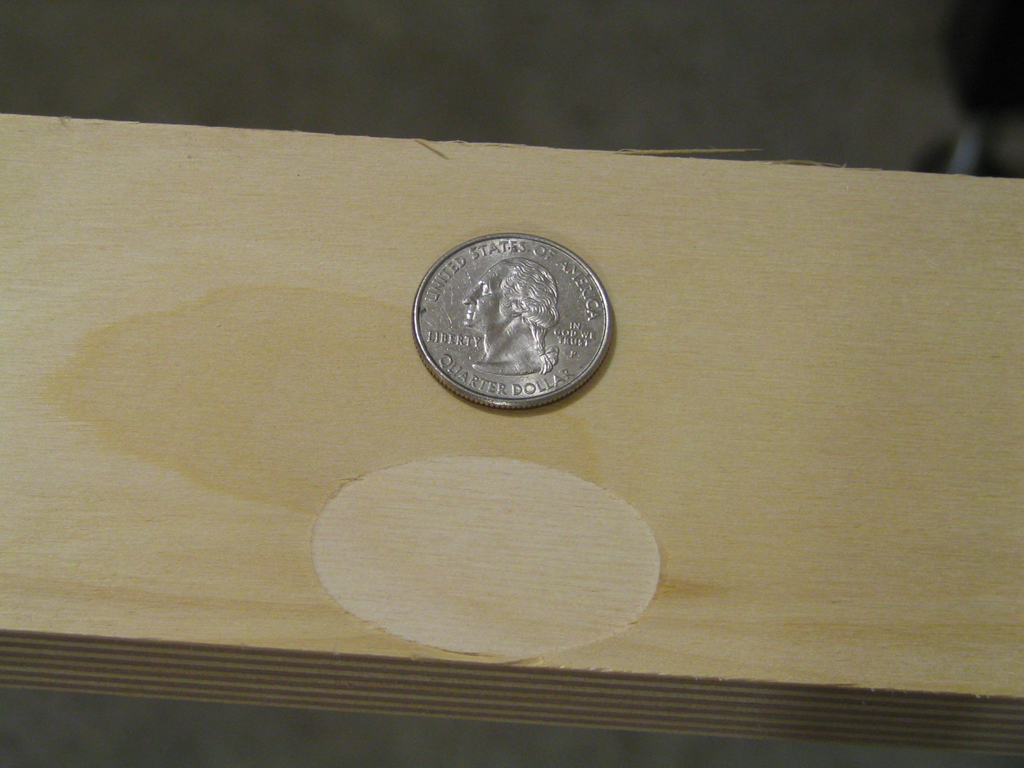
A typical patch, note how small and well fitted it is.

I am interesting in installing a plywood floor in the living/dining room and kitchen (approximately 1,000 sq. ft) of my mid-century home. My contractor is concerned about the longevity of plywood as a flooring material given the high traffic these rooms receive. Anyone know how Baltic Birch plywood floors look after a few years of use? I am also hoping to avoid having the screw heads or plugs visible – has anyone done this?
Thanks
Toby
Toby,
Don’t use plywood for the top surface of a floor, it’s not hard enough. In home construction, plywood should only be used as a sub-flooring.
We’ve had plywood on our floor for years and it still looks fine.
What!??
You can totally use BB for flooring. Come on! The mainstream Big Box retailers sell MUCH crappier utility flooring that holds up just fine. BB is perfectly fine for flooring, in fact- it’s quite “trendy” in mod construction and is regularly used as a flooring material.
Holds up fine compared to what?
Everything I have ever read has suggested Baltic birch is usually made with Yellow Birch. If that’s the case it’s only 1260 on the janka scale. That’s less than red oak, and a woman in cheap stilettos can leave marks on a read oak floor if she isn’t super petite.
not to mention the plies are only 1 to 1.5 mm thick depending on the thickness of the plywood. I think it would be pretty easy to sand through the top veneer when you eventually need to refinish the floor.
Point well made.
We take off our shoes before entering the house. Dragging in dirt, grime, sand is a sure way to damage any wood floor.
B-C-X is a great choice for an “alternative “ floor finish- structurally sound, durable. I would only recommend bb on TOP of the floor diaphragm not as replacement.
Toby; Did you do your floor in baltic birch? I am considering the same and would love to hear your experience!
Hello Dan!
Thank you for the Baltic birch info. I think you are knowledgable and maybe can give me advice on a project. Cost is a factor. I saw some artwork that was made up of about a 2″ plywood frame. The only part of this frame exposed was the sides that have the light and dark plys. Clearly two or more sheets were laminated together to make 2″. The exposed plys were perfectly planed and had a light clear coat.
My question is, are you aware of any plywood that has the light and dark plys like the baltic birch, that would be least expensive? Considering only the ply side would be seen, and the surface ply facing the wall, or glued to the underside of the painting.
Some of the pieces I will be working with are 48″ x 60″ but the width of the frame would only be inch or 2.
I hope you check these older posts. i didn’t find anywhere to contact you directly.
Well, thanks M
Hi Max,
Pretty much any plywood will have the appearance of light and Dark plies once finished. This is because of the orientation of the individual plies, Each ply is rotated 90 degrees to the previous ply. Thus when you cut through a sheet, and expose the edges what you get is long grain, end grain, long grain, end grain etc. End grain absorbs more finish than long grain, so it usually takes on a darker color than long grain. How drastic the difference in color is will depend on the finishing method being used.
With regard to type, I thing grade CP would work fine for your application, as long as you get get lucky and don’t happen to expose a void while cutting the sheet to size.
Dan,
I am trying to make table tops from 1/2″ Baltic birch plywood. It seems flat when I get it from the lumber yard. After painting (both sides) my painter stands each piece on end to dry. Drying might take several days. Most of the dry painted pieces have a slight warp afterwards. My painter tells me that if I stack them flat for a period of time, they might return to flat. Is it the painting that warps them? Or the vertical standing that allows them to warp? Will it come out if stacked flat?
Thanks
Scott
Scott,
I’m not sure what would cause it exactly, but my guess would be the paint.
Warping plywood can be a pain, but I have found it is true what Harold Payson said in his book “instant boats,” that plywood that has high humidity on one side will warp towards the other side. He would just toss the plywood on the lawn on a sunny day with the warp upwards, allowing the sun to dry the top, and the ground to humidify the bottom. Often, within that day, the sheet becomes flat again, or, if unwatched, warped in the opposite direction. Try it out with some warped scrap if you like.
Highly diffivitive desertations.
Does anybody know any thing about the glue?
id like to know who in Australia can get me 13 ply baltic birch plywood im sick of looking and talking to people who cant assist me can someone here assist me cheers
regards wayne
[…] plywood for future projects. It is far superior to "regular" birch… here's a link.. Dan's Hobbies — A baltic birch plywood primer Regarding the "Chinese vs others" discussion, I know that "traditional" BB ply […]
I would like to purchase some Baltic Birch to build speaker cabinets but I cannot find any locally.(Lowes seems to carry veneers and not the real thing…) Do I need to look at ordering from another country??
Not at all, check out some of the online lumber suppliers, Woodcraft for example has smaller sheets.
http://www.woodcraft.com/family/2004113/2004113.aspx
Do NOT use plywood for speaker cabinets. I have been building speakers since the ’60s and I can attest to the fact that MDF is the most highly recommended material to use. It is acoustically dead and will not “ring” or color the sound. I use 3/4″ MDF for the entire cabinet except the front baffle board where I use 1-1/8″ MDF or, for subwoofers, 1-3/4″ thick MDF typically laminating two 3/4″ slabs together. The extra thick front will stand up to the constant pounding by the low frequency drivers.
British loudspeaker system manufacturers Rogers, Spendor, and KEF all use, or have used Baltic Birch Plywood for their products. One of the most well known of these being the ‘legendary’ BBC monitor LS-3/5a. Some American and Canadian speaker brands have also fabricated their enclosures from baltic or Finnish Birch plywood for their ‘flagship’ products. As far as I’m aware, all of these designs have incorporated some form of vibration dampening laminate on the speaker-box interior surfaces. Typically bituminous tar as found in heavy grade roofing felt. Other synthetic treatments have also been successfully used.
Marshall and others use plywood for their speaker cabinets. MDF is a wrong choice for guitar speaker cabinets.
Thank you Nate.
I am building a higher-end custom speaker – with Scan Speak drivers. This question MDF vs. Baltic Birch is a nightmare. I want to use 1″ thick material. I am worried that MDF will sound dead. – I know, that might be a good thing.
Regards,
Tom
Yesterday, I bought “Baltic Birch Plywood” (I couldn’t find any place-of-manufacture markings such as Dan’s described above, so I’m using quote marks) at Rockler Woodworking (Maplewood Mall, north of St. Paul, MN). The sheets of BB-grade plywood were gorgeous and required only light sanding with 180 and 220 grit paper before applying 2 coats of clear satin urethane (I used no stain).
please i need to know the price of birch plywood grade pc 152.5*152.5 glue is mr please i need to knoe the price thickness 3mm
I live in Newfoundland, Canada. Sorry to say, I am not aware of any place in this province where one can purchase baltic birch. How sad !!!!! Why in god’s name doesn’t someone smarten up and get a corner on that market here at the local level! I am now using two sheets of baltic birch ( 1/2 and 3/4 )that I had someone bring in from Ontario. And, man, is it ever loaded with voids and dark ply areas( knots, I assume) throughout. That is not what I would have thought baltic birch to be like ! I’m starting to wonder if it might be some of that Chinese carp another alluded to above !
Hi Gerald, try Lumberworld Ltd. in St. John’s (709 576 7283) – I called and they do carry 5×5′ sheets of baltic birch. That’s the only place I’ve found in NL though. And I’m in Labrador! Good luck.
Noted a post from you on Sawmill Creekincluding sizes, and price ideas. Very informative. I am having a tough time finding high quality 60″ by 60″ Baltic Birch in 3/4 ” (18mm). Lots of small stuff, but I need the 5 x 5.
I am in Phoenix, AZ, but any location would be fine.
Noted your Champaign, Illinois location. I spent some time at the U of I. Fond memories.
[…] your reason, you should read the post if you intend to work with this […]
Well, I have an odd reason for purchasing Baltic Birch. My son wants to make his own Longboard (a type of skate board). I saw his directions mention Baltic Birch but I don’t know what size(s) he needs. Right now it is a challenge to find it in Massachusetts! Still looking…tried Home Depot and am looking online. Thanks for the education! I am going to have Howard look at your information.
Does anyone know the VOC content of Baltic berch? has is been tested? Is the dust safe?
I have been looking for an odd size of 5/32″ thick Baltic or Finnish Birch ply and
found some at Woodcraft. Sizes are from 1/16″ to 3/4″. The size I am purchasing is 5/32″ x 24″ x 30″. They also have listed 5/32″ x 12″ x 30″.
I need it for my RC Aircraft project EDO OSE-1 float plane center float strut.
I am wondering about the companies that supplie Baltic Birch: are they environmentally responsible companies that promote sustainability or are the manufacturors just exploiting the forests where Baltic birch is sourced? I asked my local lumber yard and they said “we have no clue where it comes from.”